


Space-Saving Shower Handle Designs for Modern Boutique Hotels and Apartments
For modern boutique hotels and compact apartments, the best Shower Handle designs are the ones that combine a small footprint,comfortable grip, durable material, and easy cleaning in dimensions that fit tight bathroom layouts. In practical terms, that usually means slim pull handles in the 120 mm to 300 mm range, low-profile knobs with a projection of around 35 mm to 60 mm, or back-to-back tubular designs sized for tempered glass doors between 6 mm and 12 mm thick. These formats save usable space because they reduce visual bulk and avoid awkward door interference, so small bathrooms feel more open without sacrificing daily comfort. Boutique hotels especially benefit from compact hardware because every 1 m² counts in guest-facing design, while apartments need handles that perform well under repeated daily use in limited layouts. The right choice also depends on finish, maintenance, and installation quality. A well-made Shower Handle in stainless steel, brass, or zinc alloy can support a cleaner aesthetic, smoother circulation, and better long-term value in projects targeting stylish, efficient bathroom design for 2026 and beyond.
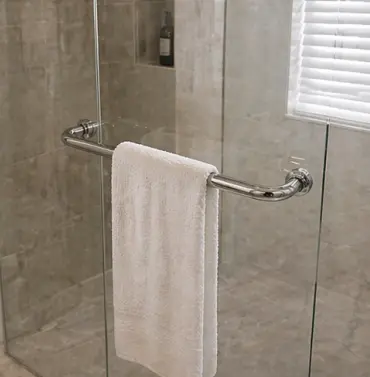
- 120 mm to 300 mm handle lengths are ideal for many compact shower doors in boutique hotels and apartments.
- 35 mm to 60 mm projection depth helps save clearance in bathrooms under 5 m².
- 6 mm to 12 mm tempered glass compatibility is a common target for modern shower door hardware.
- Quality finishes can reduce visible spotting in hard-water environments by up to 1 cleaning cycle per week compared with highly polished surfaces.
- Hospitality projects should consider hardware life across 3 years to 10 years of repeated use, depending on traffic level and maintenance routine.
Why space-saving shower handles matter more now
Bathroom planning has changed. Developers, hotel owners, and interior designers are trying to create premium experiences in smaller footprints, often under 4 m² to 8 m² per bathroom. That shift makes every hardware detail more visible. A bulky handle can interrupt movement, dominate the sightline, and make a shower enclosure feel heavier than it really is.
A compact Shower Handle matters because the hand touches it every day, so it is not just a decorative accessory. It affects comfort, safety, hygiene, and the overall perception of quality. In a boutique hotel, hardware becomes part of the guest impression within the first 10 seconds of entering the bathroom. In an apartment, it becomes part of the daily routine over 365 days per year.
Small bathrooms need hardware that works harder. A slim design improves circulation because users can move more freely around the vanity, shower screen, and towel zone, so the room feels less cramped. A shorter projection also reduces accidental contact because it stays closer to the glass plane, so tight corner layouts become easier to manage.
What design types save the most space?
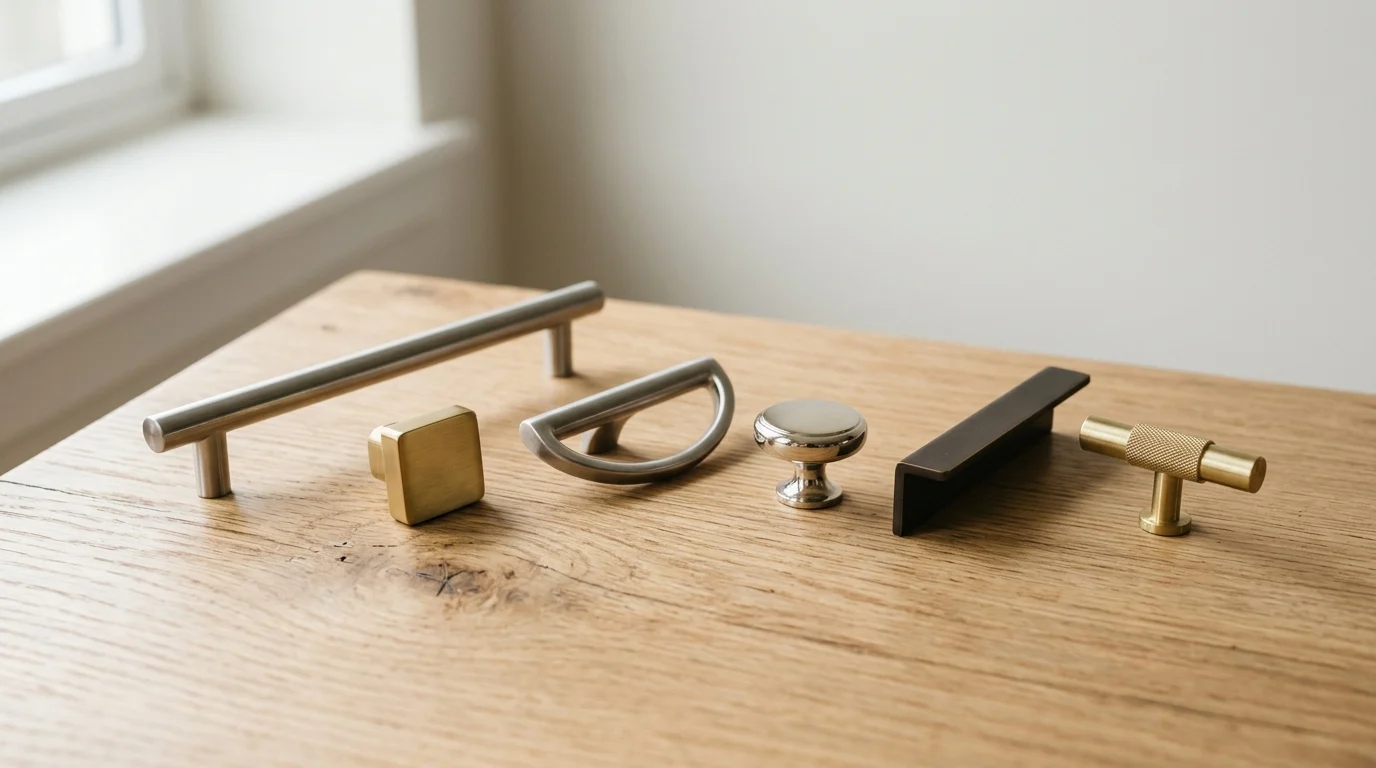
1. Slim tubular pulls
Slim tubular pulls are a favorite for frameless enclosures. Diameters around 16 mm to 22 mm feel substantial without looking oversized. Lengths between 180 mm and 300 mm often provide a good balance for hotel and apartment projects.
They work well because the profile is visually light, so the glass remains the main design feature. They also clean quickly because there are fewer corners where residue can build up, so maintenance teams save labor time.
2. Compact knobs
Compact knobs are ideal where door clearance is extremely tight. A projection of 35 mm to 50 mm can make a noticeable difference in narrow walkways or toilet-adjacent layouts.
They save space because the hardware occupies less depth, so the enclosure can sit closer to other fixtures. However, grip comfort may be lower for some users if the shape is too small.
3. Flat rectangular pulls
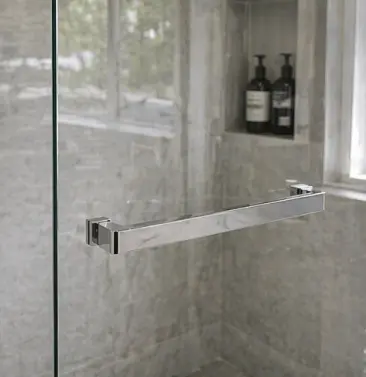
Flat rectangular pulls suit contemporary interiors with clean lines. Widths around 20 mm to 30 mm and lengths from , are common in upscale bathrooms.
These designs are effective because they present a strong geometric look, so they pair naturally with square faucets, linear drains, and minimalist tile layouts.
4. Back-to-back dual handles
Back-to-back handles improve usability on both sides of the glass. This is useful for boutique hotels where housekeeping access and guest access both matter across multiple cleaning cycles per day.
They are especially practical because opening force is distributed more naturally, so larger glass doors can feel easier to operate even in compact enclosures.
Best materials for compact shower handle design
Material selection is critical in wet environments. The most common options are stainless steel, brass, and Zinc Alloy. Each one can be a smart choice when used properly.
| Material | Typical advantage | Common use range | Best fit |
|---|---|---|---|
| Stainless steel | Strong corrosion resistance | 6 mm to 12 mm glass door setups | High-moisture hospitality bathrooms |
| Brass | Reliable weight and machining quality | 120 mm to 300 mm pull handles | Premium apartments and luxury rooms |
| Zinc Alloy | Precise die-cast form for compact shapes | 35 mm to 60 mm projection designs | Decorative modern handle styles |
Stainless steel performs well in frequent-use bathrooms because moisture exposure is constant, so corrosion resistance becomes a major factor over 3 years to 10 years. Brass is valued for premium feel because it has structural stability, so designers often choose it for upscale boutique applications. Zinc Alloy is useful for small, intricate forms because die-casting supports repeatable shape control, so manufacturers can create compact decorative hardware without excessively high machining time.
How dimensions influence comfort and clearance
Saving space should never make a handle awkward to use. The right dimensions depend on hand comfort, glass door size, and surrounding fixture distances.
- Handle length: 120 mm to 180 mm for tighter doors, 180 mm to 300 mm for better grip on larger panels.
- Grip diameter: around 16 mm to 22 mm for many adult users.
- Projection depth: 35 mm to 60 mm to minimize interference.
- Glass thickness compatibility: usually 6 mm, 8 mm, 10 mm, or 12 mm.
- Mounting hole spacing: often set in manufacturer-specific increments such as 145 mm or 200 mm.
A handle that is too short may feel unstable because leverage is limited, so users may pull the glass at awkward angles. A handle that projects too far can bump nearby fixtures because compact layouts leave little room, so even an extra 20 mm can affect movement. This is why dimension planning matters just as much as finish selection.
📌 Design rule: In bathrooms below 5 m², prioritize lower projection depth first, then optimize grip comfort second, and then finalize the visual style third.
Best finishes for modern boutique hotels and apartments
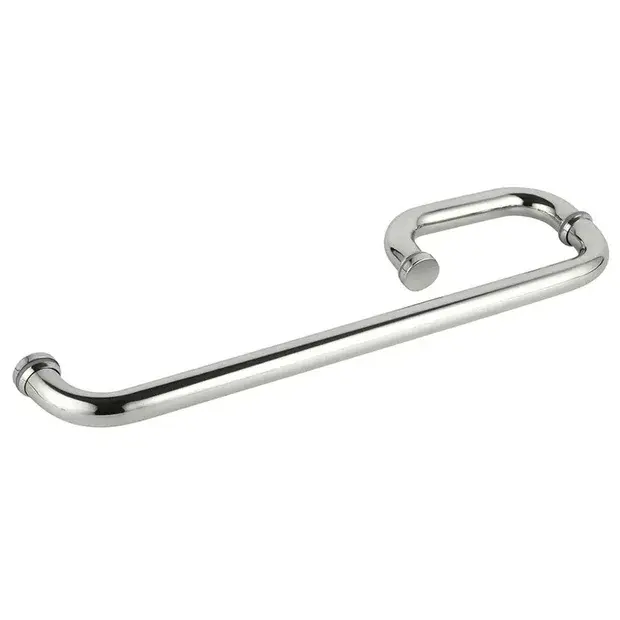
Finish selection changes how large or small a shower area appears. Polished chrome reflects light well and can brighten compact spaces, while brushed nickel often hides fingerprints better. Matte black creates sharp contrast in minimalist interiors, and satin stainless supports a clean architectural look.
In hospitality settings, the finish has to work beyond appearance. A polished surface may look striking because it catches ambient lighting, so it can enhance premium visual impact. But in hard-water regions, brushed finishes are often easier to maintain because they soften the visibility of mineral marks, so housekeeping labor can become more predictable over 7 days of operation.
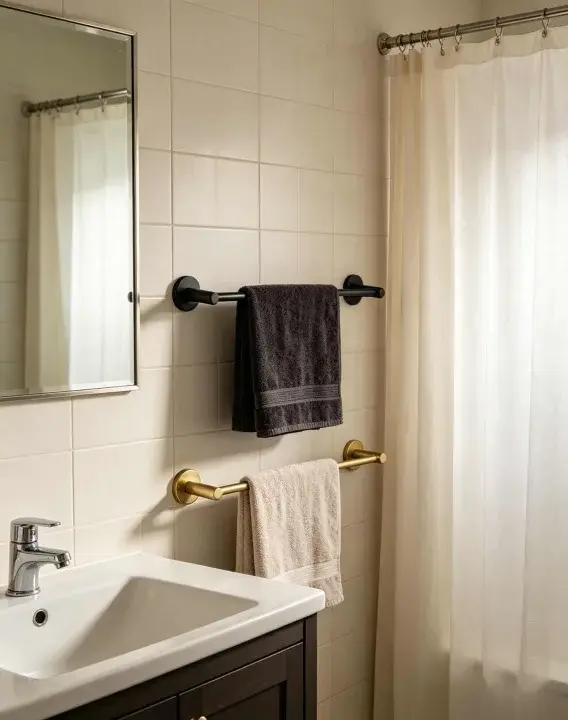
For apartments, finish coordination matters because the shower hardware should align with faucet trim, hinges, Towel Bars, and cabinet pulls. A cohesive palette across 4 fixtures to 8 fixtures makes a smaller room feel more intentional.
Design strategies for boutique hotels
Boutique hotel bathrooms are judged on atmosphere as much as function. The hardware should feel refined without competing against the tile, glass, and lighting. Compact pull handles often work best in guest rooms between 18 m² and 35 m² where bathroom space is carefully edited.
Hotels should choose hardware with consistent finishes, repeatable mounting specifications, and easy replacement pathways. This matters because maintenance teams need reliable spare parts, so room downtime can be minimized when damage occurs. Back-to-back designs are helpful because both guest use and housekeeping use are frequent, so operational convenience improves.
Another useful strategy is standardization. If a hotel uses one handle family across 20 rooms to 200 rooms, procurement becomes simpler because inventory management is easier, so replacements can happen faster and visual consistency remains intact.
Design strategies for apartments and small residential projects
In apartments, the Shower Handle must support daily use without making the bathroom feel crowded. Designers often prefer low-profile handles on sliding enclosures because swing clearances are removed, so the bathroom can function better in narrow plans. For hinged doors, a compact pull or knob may be enough if the opening arc is already tight.
Residential buyers also care about touch quality. A handle should feel solid at every use because tactile feedback influences perceived value, so even small hardware can elevate the whole bathroom. Compact hardware is especially useful near vanities spaced within 400 mm to 700 mm of the shower edge, where protrusions can otherwise create conflict.
Installation factors that protect long-term performance
Even the best Shower Handle can fail if installation is poor. Correct fit depends on glass thickness, gasket quality,fastener material, and torque control. Installers should confirm hole diameter, center-to-center spacing, and edge distance before fixing hardware onto tempered glass.
Installation quality matters because misalignment can create stress on the glass, so both safety and durability may suffer. Proper gaskets matter because metal-to-glass contact should be isolated, so chips and pressure points are less likely. Fasteners matter because bathroom humidity is continuous, so corrosion-resistant screws help preserve the appearance and structural integrity over time.
For hospitality projects, test one complete mock-up before ordering 50 units to 500 units. For apartment developments, verify handle clearance against vanity corners, towel rails, and door frames within the actual bathroom layout.
Cleaning and maintenance in high-use bathrooms
Maintenance is often ignored during design selection, but it strongly affects lifecycle value. A compact Shower Handle with smooth geometry is easier to wipe than a decorative handle with deep grooves and layered trim.
Cleaning routines should include a soft cloth, non-abrasive cleaner, and regular drying after use where possible. This is especially important in hard-water areas because mineral residue forms quickly, so visible spotting can reduce the premium look in just 24 hours. Avoid harsh chemicals that may damage coatings within 1 month to 12 months of repeated exposure.
Hotel staff benefit from simple shapes because cleaning speed matters across many rooms, so maintenance labor becomes more efficient. Apartment owners benefit because easier cleaning supports better long-term appearance with less effort each week.
What to ask before specifying a shower handle
Before placing an order, buyers should ask practical questions:
- does the handle support: 6 mm, 8 mm, 10 mm, or 12 mm?
- What is the projection depth in mm?
- What finish testing has been completed, including humidity or salt exposure?
- What screw material is used?
- What is the lead time in days?
- Is custom hole spacing possible in mm?
- How is packaging protected for transport over long distances?
These details matter because product drawings do not always show installation realities, so early clarification prevents expensive rework. They also matter because boutique hotels and apartments often have repeated unit layouts, so one wrong dimension can affect dozens of bathrooms at once.
2026 direction: where compact shower hardware is heading
Looking toward 2026, the strongest direction is not simply smaller hardware, but smarter compact hardware. Buyers increasingly want handles that deliver a refined silhouette, durable coatings, consistent manufacturing tolerance, and compatibility with minimalist glass systems. The visual goal is “less hardware, better performance.”
Expect more demand for matte finishes, mixed-metal coordination, and precisely cast compact forms. Projects are also leaning toward standardized modular parts because sourcing stability matters, so replacement and maintenance can be managed more efficiently over long occupancy cycles.
FAQ
The best style is usually a slim pull handle or a compact back-to-back design in the 120 mm to 250 mm range. These styles work well in small hotel bathrooms because they keep the enclosure visually light, so guests perceive more openness. They also support quick housekeeping access and generally pair well with frameless glass, stone finishes, and minimalist fixtures.
A compact enclosure often works well with a handle length between 120 mm and 300 mm. For narrow doors, 120 mm to 180 mm can be enough, while heavier or taller panels may benefit from 180 mm to 300 mm. The correct choice depends on door weight, user comfort, and door width because a larger panel needs better leverage, so a longer grip may feel more natural.
Stainless steel is often the safest all-around choice for hospitality settings due to its corrosion resistance and solid mechanical performance. Brass is also highly reliable and often selected for premium projects, while zinc alloy can be a strong option for precisely shaped compact parts. The best material depends on use intensity, finish requirements, and budget per room in USD terms.
Yes, frameless shower handles can be safe in apartments when they are installed correctly on tempered glass with proper gaskets and the correct hole spacing. Safety depends on matching the handle to the glass thickness, usually between 6 mm and 12 mm. If the hardware is mismatched or over-tightened, stress concentration can increase because the glass is not supported correctly, so professional installation is important.
In many cases, yes. Compact handles with smooth, simple forms are easier to clean because they have fewer recesses, so soap film and mineral deposits are easier to remove. This advantage is significant in hotels where staff may clean many bathrooms in 1 shift of 8 hours, and in apartments where owners prefer quick weekly maintenance.
Brushed nickel, satin stainless, and well-coated matte black finishes are often more forgiving in hard-water regions than mirror-polished chrome. They are practical because visible spotting tends to stand out less on textured or satin surfaces, so the hardware can look cleaner between maintenance cycles. That said, every finish still benefits from regular drying and non-abrasive cleaning.
They can support accessibility goals, but they should not be treated as dedicated support bars unless they are engineered and rated for that purpose. Designers can improve usability by choosing a comfortable grip diameter of around 16 mm to 22 mm, placing the handle at an intuitive reach height, and ensuring visual contrast where needed. Usability matters because limited bathroom space can challenge movement, so better grip design can reduce effort during daily use.
Buyers should ask about material grade, finish process, testing methods, glass compatibility, screw and gasket quality, packaging protection, customization in mm, and lead time in days. These questions matter because a compact handle must fit precisely, so small dimension errors can create installation problems across multiple units. In hotel or apartment projects, one specification mistake can affect 10 rooms to 100 rooms at once.
Conclusion
The ideal Shower Handle for modern boutique hotels and apartments is not simply the smallest option. It is the design that saves space while preserving grip comfort, visual balance, durability, and easy maintenance. In most compact bathrooms, that means choosing a streamlined handle with a projection of 35 mm to 60 mm, a practical length of 120 mm to 300 mm, and a material suited to moisture and daily use. When specified correctly, compact shower hardware improves circulation because the room feels less obstructed, so the bathroom becomes both more elegant and more functional. That is exactly why space-saving handle design will remain a smart choice for 2026 projects in hospitality and residential interiors alike.