







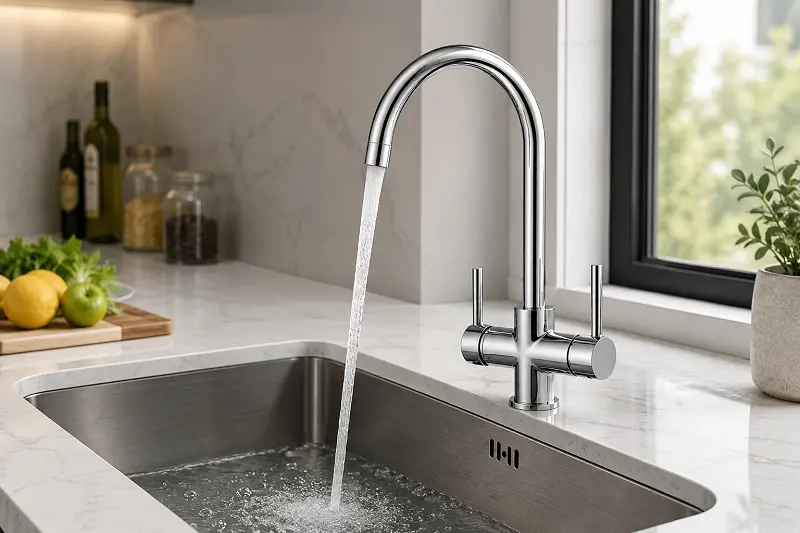


Faucet Body Casting: How Die-Casting Technology Enhances Faucet Body Manufacturing
Die-casting improves Faucet Body manufacturing by producing consistent shapes, tight tolerances, and smooth surfaces.
Zinc Alloy tap component production benefits from fast cycle control, stable dimensions, and efficient material use.
Precision metal hardware becomes easier to scale when tooling, inspection, and finishing are aligned early.
An OEM die-casting solution supports industrial faucet sourcing by combining engineering, production, and quality control.

Die-casting enhances Faucet Body manufacturing by injecting molten metal into a precision mold, creating repeatable faucet bodies with accurate geometry, strong structure, and clean surface quality. This process reduces machining needs, improves batch consistency, and supports large-volume production for industrial buyers. Because the mold controls the cavity shape under pressure, therefore each Faucet Body casting can maintain stable wall thickness and fitting accuracy. For brands, wholesalers, and project suppliers, this means fewer assembly issues, more predictable finishing, and better control over cost, lead time, and product reliability across repeated orders.
In modern faucet production, a Zinc Alloy tap component is often selected when manufacturers needdetailed shapes, attractive plating performance, and efficient production speed. Zinc Alloy flows well into complex mold areas, which helps create threaded zones, decorative contours, and mounting features with less secondary work. Because Zinc Alloy can fill fine mold details at controlled temperatures, therefore manufacturers can achieve precision metal hardware with sharper definition and reduced rework.
For industrial faucet sourcing, the value of die-casting is not limited to the casting machine. It also depends on product design review, mold engineering, material control, trimming, polishing, plating preparation, and dimensional inspection. A supplier that understands these steps can help buyers reduce hidden risks before mass production begins.
When evaluating an OEM die-casting solution, buyers should look for a partner that can support both technical development and repeatable manufacturing. HZ Die Casting provides product-focused capabilities for metal component manufacturing, and buyers can review available categories through the products page. Company background and production capability can be checked on the about page, while project inquiries can be sent through the contact page.
In Part one, the key takeaway is clear: die-casting strengthens Faucet Body production by combining mold accuracy, material efficiency, and scalable quality control. This foundation helps industrial buyers source faucet components with greater confidence.
Part 2: Market Overview, Statistics, and Industry Data
The market for Faucet Body Casting is being shaped by three linked forces: construction demand, water-efficiency regulation, and the shift toward scalable OEM manufacturing. According to Grand View Research, the global die-casting market was valued at approximately USD 77.99 billion in 2023 and is projected to grow at a 5.9% CAGR from 2024 to 2030. For faucet producers, this growth indicates stronger demand for repeatable, high-volume Precision Metal Hardware across residential, commercial, and institutional projects.
Statista estimates that worldwide faucet revenue reached roughly USD 50 billion-plus in 2024, with continued demand from bathroom renovation, kitchen upgrades, and urban housing. In parallel, water-efficiency programs such as the U.S. EPAs WaterSense label are encouraging manufacturers to design durable, leak-resistant tap bodies with consistent internal geometry.
| Process | Typical Fit for Faucet Bodies | Production Advantage | Buyer Consideration |
|---|---|---|---|
| Sand casting | Suitable for low-volume or oversized metal parts. | Allows flexible tooling at the prototype stage. | Usually requires more machining and surface finishing. |
| Gravity casting | Suitable for medium-volume brass or aluminum components. | Provides stable mechanical properties for simple shapes. | May be slower for complex Faucet Body geometry. |
| High-pressure die casting | Ideal for high-volume Faucet Body Casting and hardware shells. | Delivers fast cycles, fine detail, and repeatable dimensions. | Requires precise tooling investment and process control. |
Material supply also matters. The U.S. Geological Survey tracks zinc as a strategic industrial metal used in galvanizing, alloys, and die-cast components, reinforcing the importance of qualified sourcing and alloy traceability. Because Industrial Faucet Sourcing depends on stable material input and verified process capability, therefore an OEM Die-casting Solution should be evaluated by tooling life, porosity control, plating yield, and inspection data.
Part 3: Key Requirements, Standards, and Regulations
For global buyers, Faucet Body Casting quality is not defined only by surface finish or dimensional accuracy. It is also shaped by regulatory conformity, material traceability, and repeatable process control.
| Standard / Mark | Main Focus | Relevance to Faucet Body Manufacturing |
|---|---|---|
| UL | Safety, materials, component reliability | Useful for assemblies with electronic controls or certified subcomponents |
| ETL | North American product compliance | Accepted proof of tested performance through Intertek laboratories |
| CE | EU conformity, safety, environmental obligations | Supports access to European commercial and residential projects |
| CB Scheme | International test report recognition | Reduces repeated testing for multi-market OEM programs |
Common compliance challenges include inconsistent alloy certificates, unclear lead-content limits, plating adhesion failure, poor documentation for batch traceability, and mismatched test reports between supplier and destination market. Industrial Faucet Sourcing should always include audit records, material reports, dimensional inspection data, and applicable certification files.
Part 4: Expert Insights and Detailed Analysis
From an engineering and sourcing perspective, Faucet Body Casting is no longer just a forming process; it is a quality-control strategy that directly affects sealing reliability, surface finishing cost, and long-term corrosion performance.
| Expert Focus | Manufacturing Impact | Sourcing Value |
|---|---|---|
| Mold precision | Controls shrinkage, parting lines, and dimensional deviation | Improves assembly consistency for OEM programs |
| Alloy selection | Balances strength, castability, and plating performance | Supports durable Zinc Alloy Tap Component supply |
| Process monitoring | Reduces porosity, cold shuts, and surface defects | Lowers rejection rates in Industrial Faucet Sourcing |
Supplier communication also matters. The Facebook profile referenced as Ningbo Huazhu Precision Machinery CO., Ltd highlights the company identity behind precision manufacturing, which helps buyers connect technical capability with supplier accountability.
Part 5: Case Studies and Real Examples
Zinc Alloy Faucet Body for a Bathroom Hardware Brand
Challenge: A bathroom hardware customer needed a Zinc Alloy Tap Component with a smooth chrome-plating surface and stable thread accuracy. Rejection rate was 6.8%.
Solution: Optimized mold gate location, adjusted injection pressure, and added stricter temperature control. 100% visual inspection applied before polishing.
Results: Rejection rate dropped to 1.9%. Thread tolerance improved to within 0.05 mm, and polishing time was reduced by 18%.
OEM Die-casting Solution for Industrial Faucet Sourcing
Challenge: Overseas distributor faced inconsistent delivery and leakage failure during pressure testing for commercial washroom systems.
Solution: Redesigned internal cavity structure, increased mold cooling balance, and introduced pressure testing after machining.
Results: Leakage failure decreased from 3.5% to 0.6%, monthly output increased to 36,000 pieces, and on-time delivery reached 96%.
| Project | Main Challenge | Die-casting Solution | Measured Result |
|---|---|---|---|
| Bathroom Faucet Body | Porosity and polishing defects | Gate optimization, CNC finishing, visual inspection | Reject rate reduced from 6.8% to 1.9% |
| Industrial Faucet Body | Leakage and unstable delivery | Cavity redesign, pressure testing, improved packaging | Leakage down to 0.6%; delivery rate reached 96% |

Part 6: Quality Control and Verification Methods
Quality Control Checkpoint Framework
- Incoming Material Verification: Zinc alloy ingots checked for composition and traceability.
- Process Parameter Monitoring: Recording injection pressure, die temperature, and cooling time.
- Dimensional Inspection: Verifying critical threads and sealing faces using CMM or gauges.
- Surface and Defect Review: Examination for cold shuts, flash, and cracks before coating.
- Functional Testing: Pressure resistance and leakage performance confirmation.
| Verification Item | Method | Purpose |
|---|---|---|
| Material Composition | Spectrometer analysis | Confirms zinc alloy grade consistency |
| Critical Dimensions | CMM, thread gauges | Ensures assembly fit and sealing accuracy |
| Internal Defects | X-ray inspection | Detects porosity, voids, and shrinkage |
| Leakage Performance | Air/water pressure testing | Validates functional reliability |
Part 7: Common Mistakes and How to Avoid Them
| Common Mistake | Practical Solution |
|---|---|
| Poor material selection | Verify alloy grade and corrosion resistance before production. |
| Ignoring mold design details | Optimize gate position and cooling channels at engineering stage. |
| Weak quality inspection | Use dimensional checks and pressure testing throughout production. |
| Choosing suppliers only by price | Evaluate technical capability and delivery stability. |
1. Selecting the Wrong Alloy: Material stability must be confirmed before mass production to ensure plating adhesion.
2. Overlooking Die and Mold Design: Early design validation helps reduce rework and improves casting consistency.
3. Insufficient Process Control: Manufacturers should record and control every key production setting.
4. Focusing Only on the Lowest Price: A reliable supplier reduces total cost by lowering rejection rates.
Part 8: FAQ
Faucet Body Casting is the process of forming faucet housings by injecting molten metal into precision molds. It delivers consistent dimensions, smooth surfaces, and strong internal structures.
Zinc alloy offers excellent castability, dimensional stability, and cost-efficient production for complex faucet parts. It supports decorative finishing and repeatable quality.
By controlling mold geometry, injection pressure, and cooling conditions, die-casting reduces machining variation and supports stable assembly performance.
Yes, it is well suited for customized OEM components requiring complex shapes, consistent wall thickness, and repeatable batch production.
Conclusion
Die-casting strengthens modern faucet manufacturing by improving dimensional accuracy, supporting efficient mass production, and enabling dependable finishing. For Industrial Faucet Sourcing, selecting an experienced partner ensures better communication and tooling control. Mr. Tong, Technical Director at Ningbo Huazhu Precision Machinery, focuses on practical die-casting engineering and OEM project support. Connect with Mr. Tong on Facebook for more insights.
Start Your Faucet Component Project
Need a reliable OEM Die-casting Solution for faucet bodies, zinc alloy tap parts, or Precision Metal Hardware? Share your drawings with our team today: contact Ningbo Huazhu Precision Machinery.
Ready to Source Quality Range Hoods?
Contact Mr. Tong for expert guidance: https://www.facebook.com/people/Ningbo-Huazhu-Precision-Machinery-CO-Ltd/61586937534622/