



Introduction
Reliable Furniture Hardware can determine whether a B2B production schedule stays on track or slips under the weight of delays, defects, and warranty issues. In commercial furniture manufacturing, components such as hinges, drawer slides, locks, and brackets may represent a modest share of total cost, yet they have an outsized impact on durability, assembly efficiency, and after-sales performance. This article explains why hardware sourcing deserves strategic attention, what risks commonly disrupt procurement, and how buyers can evaluate suppliers beyond unit price alone. From lead times and quality consistency to technical support and scalability, the discussion sets up a practical framework for building a more dependable Furniture Hardware supply chain.
Why Furniture Hardware Sourcing Matters in B2B Procurement
I've spent years analyzing B2B supply chains, and if there's one thing I've learned, it's that the smallest components often cause the biggest headaches. When we talk about assembling commercial desks, hotel case goods, or modular office partitions, the structural integrity relies entirely on the hardware holding it together.
If you're managing procurement, you already know that sourcing these parts isn't just about finding the cheapest metal. It's about securing a reliable pipeline that keeps your assembly lines moving without eating into your margins or causing late-stage quality control disasters.
Defining furniture hardware in a B2B context
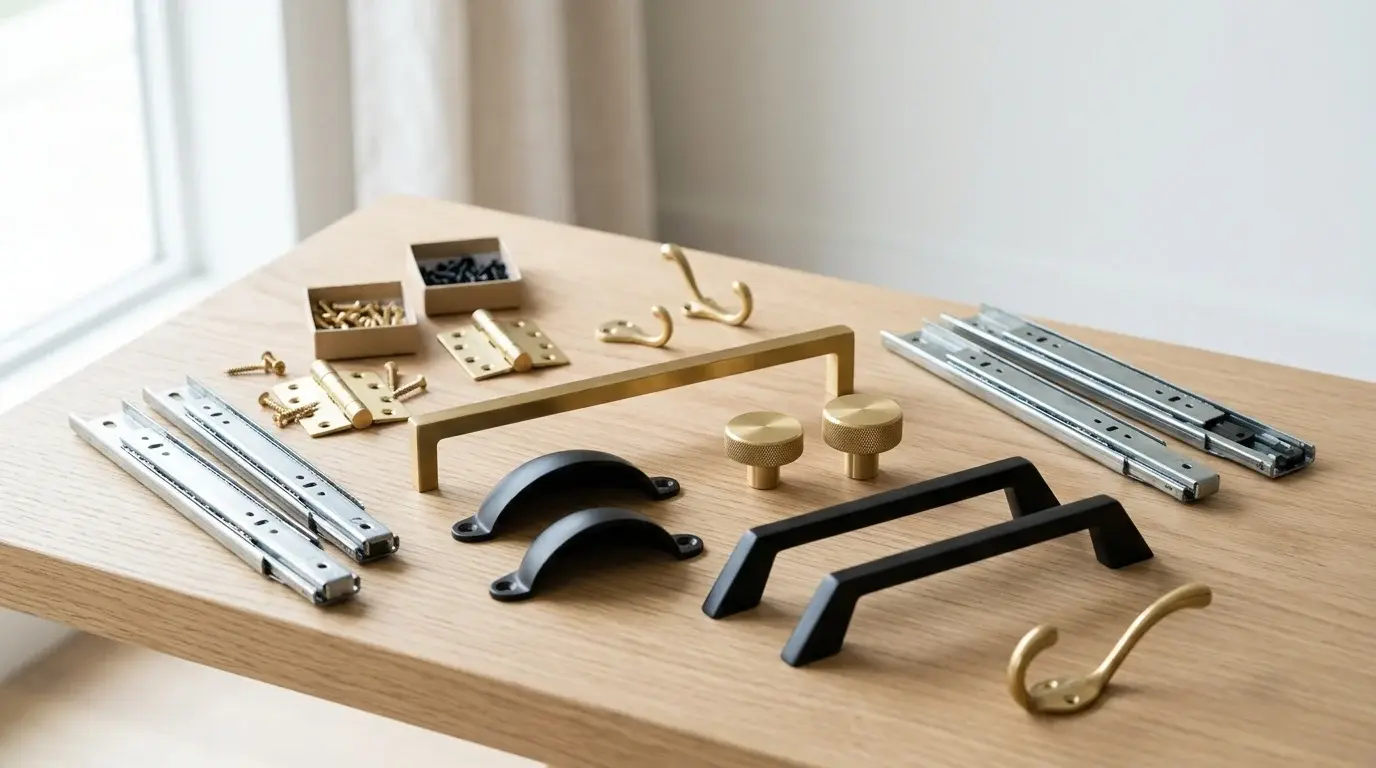
In a B2B manufacturing context, furniture hardware goes way beyond the decorative knobs you see at a local hardware store. We are talking about precision-engineered internal mechanisms: concealed hinges, heavy-duty drawer slides, locking cylinders, and structural brackets.
For instance, specifying the right Heavy Duty Hinges can dictate the entire lifecycle and user experience of a commercial cabinet. Interestingly, while these hardware components typically only account for 5% to 15% of the total Bill of Materials (BOM) cost, they are responsible for nearly 80% of functional product failures and warranty claims if you source sub-standard parts.
Key cost, lead-time, and service risks
The risks in hardware sourcing are real and can severely disrupt your operations. Cost volatility in raw materials like zinc, aluminum, and steel can wipe out your profit margins overnight if your contracts aren't locked in properly.
Then there's the lead-time nightmare. I've seen standard lead times stretch from a manageable 30 days to a crippling 90 to 120 days during global shipping crunches. If your supplier lacks robust inventory management or relies too heavily on unvetted sub-tier vendors, a single delayed shipment of specialized fasteners can bring your entire $50,000-per-day assembly line to a grinding halt. Furthermore, inconsistent service and poor communication turn minor production hiccups into major delays.
How to Evaluate Reliable Furniture Hardware Suppliers
So, how do we weed out the unreliable vendors from the true manufacturing partners? In my experience, evaluating a supplier requires looking past their glossy catalogs and digging into their actual production capabilities and quality assurance protocols.
You want a partner with a proven track record rather than a middleman. Take Ningbo Huazhu Precision Machinery Co., Ltd., for example. Established in 2007 and rebranded in 2015, they evolved into a full-service manufacturing enterprise that integrates R&D, production, and sales. That kind of longevity, vertical integration, and deep engineering expertise is exactly what you should look for when vetting potential partners.
Core criteria for comparing suppliers
When comparing suppliers, I always start with their quality control specs and material tolerances. Are they using high-grade 304 stainless steel or cheaper, rust-prone alternatives? Can their finishes withstand a standard 48-hour to 96-hour salt spray test?
You also need to assess their flexibility with Minimum Order Quantities (MOQs). A reliable supplier should be able to handle standard MOQs of 5,000 to 10,000 units without a hitch, while still offering custom tooling for specialized parts. Don't forget to check their catalog breadth. Consolidating your orders is much easier when a supplier can provide everything from complex Furniture Connectors to simple Magnetic Catches. A consolidated supplier base actively reduces your administrative burden and lowers inbound freight costs.
Best decision tools for supplier benchmarking
To make an objective decision, I highly recommend using a weighted scorecard. This tool helps you benchmark potential partners across the metrics that actually impact your bottom line, removing emotion and sales pitches from the equation.
Here is a simplified example of how I set up a supplier benchmarking matrix:
| Evaluation Metric | Supplier A (Integrated Mfg) | Supplier B (Trading Co.) | Target Baseline |
|---|---|---|---|
| Defect Rate (AQL) | 0.3% | 1.5% | < 0.5% |
| Standard Lead Time | 35 Days | 60 Days | 40 Days |
| Tooling Cost ($) | $1,200 | $800 | < $1,500 |
| MOQ Flexibility | 5,000 units | 20,000 units | 10,000 units |
By laying out the data like this, it becomes glaringly obvious that saving a few hundred dollars on upfront tooling with Supplier B just isn't worth the massive hit you'll take on defect rates and lead times.
How to Optimize the Furniture Hardware Procurement Process
Once you've shortlisted your top candidates, the work shifts from evaluation to active optimization. Procurement isn't a 'set it and forget it' task; it's a dynamic, ongoing process that requires constant tweaking to maximize efficiency and reduce overhead.
I've found that the best procurement teams treat their suppliers as true extensions of their own business, actively integrating forecasting data, sharing long-term production schedules, and standardizing structural components wherever possible to drive down costs.
Practical steps to improve sourcing
One of the most practical steps you can take right now is SKU rationalization. Take a hard look at your engineering drawings: do you really need twelve different screw lengths and thread pitches across your product lines? By standardizing your Bulk Screws and Plastic Inserts, you can dramatically increase your order volumes for fewer specific parts. This consolidation often unlocks volume discounts of 8% to 15%.
Another highly effective tactic is implementing Vendor Managed Inventory (VMI) or negotiating blanket purchase orders. By committing to an annual volume of 100,000 units and taking staggered monthly deliveries, you can secure better pricing while reducing your on-hand safety stock by up to 20%, freeing up valuable warehouse space and working capital.
How to make the final supplier decision
Making the final supplier decision ultimately comes down to mitigating risk through hands-on validation. I never award a full annual contract based on a single golden sample provided by a sales rep. Instead, I insist on a paid pilot run—usually around 500 to 1,000 units—using the actual mass-production tooling.
This trial phase lets you test their real-world production speed, the durability of their packaging, and their
Key Takeaways
- The most important conclusions and rationale for Furniture Hardware
- Specs, compliance, and risk checks worth validating before you commit
- Practical next steps and caveats readers can apply immediately
Frequently Asked Questions
Why is furniture hardware so critical in B2B supply chains?
Because small parts like hinges, slides, and connectors often drive product function, assembly speed, and warranty risk. Poor hardware can delay production and increase failure rates.
How can I verify a furniture hardware supplier is a real manufacturer?
Check for in-house R&D, production, and quality control, not just a catalog. Review factory capabilities, material specs, and request samples or an audit.
What quality checks should I request for furniture hardware?
Ask for material certificates, tolerance standards, AQL targets, and finish testing such as 48–96 hour salt spray results. These help confirm durability and consistency.
What lead time and MOQ benchmarks are practical for B2B furniture hardware?
For many standard parts, 30–40 days lead time and 5,000–10,000 unit MOQs are reasonable targets. Confirm buffer stock and tooling timelines for custom items.
Can www.huazhuprecision.com support consolidated furniture hardware sourcing?
Yes, www.huazhuprecision.com highlights integrated manufacturing and a broad Furniture Hardware range, including hinges, connectors, and magnetic catches, which can help reduce vendor count and freight complexity.