

Maximizing Structural Integrity: The Importance of Precision Glass Door Fittings
Precision Glass Door Fittings matter because they are the hidden structural link between a beautiful glass panel and a safe, reliable door system. When fittings are engineered with tight tolerances of about 0.10 mm to 0.30 mm, matched to glass thicknesses such as 8 mm, 10 mm, or 12 mm, and made from corrosion-resistant materials like stainless steel, they help control load transfer, reduce stress concentration, and keep doors aligned over thousands of opening cycles. That is essential in residential entrances, commercial partitions, and every Shower Room Glass Accessory application.
Structural integrity improves when each component works as a coordinated system: the Precision Glass Clamp holds the panel securely, the Glass-to-Wall Bracket anchors the panel to the substrate, and the Stainless Steel Support Rod limits deflection across wider spans such as 800 mm to 1500 mm. A properly selected Heavy Duty Glass Fitting also prevents overloading because it is designed for defined weight ranges such as 35 kg, 50 kg, or 80 kg, so the assembly remains stable instead of developing looseness, vibration, or edge damage. In short, precise fittings are important because they protect glass, support safe movement, and extend service life by many 5 years to 15 years when maintained correctly.
Glass architecture is often judged by clarity, minimal lines, and clean reflections. Yet the visual effect only lasts when the hardware underneath is engineered correctly. Glass Door Fittings do not simply decorate a panel; they manage forces created by weight, impact, repeated motion, humidity, and installation variables. A glass door may look stable on day 1 day, but if a hinge cutout is slightly misaligned or a clamp compresses unevenly by only 1 mm to 2 mm, long-term problems can begin.
This happens because glass is strong in compression but sensitive to edge flaws, so fittings must distribute force carefully rather than pinch the panel at a single harsh point. It also happens because doors move through repeated cycles, so every screw seat, gasket surface, and clamping face must maintain predictable contact over time. Precision is not a luxury. It is the condition that makes a glass system structurally trustworthy.
Explore more product options and system details here:
https://www.huazhuprecision.com/glass-door-fittings/
A complete assembly usually includes hinges, clamps, brackets, support rods, connectors, gaskets, and fasteners. Each part contributes to how force travels from the glass panel into the wall, frame, floor, or adjacent glass. Load transfer is the key principle. If the load path is smooth, the system feels solid. If the load path is interrupted, the door may sag, chatter, bind, or crack.
For example, a Precision Glass Clamp must maintain even pressure over a controlled contact area, often with non-marring gaskets sized for 8 mm to 12 mm glass. A Glass-to-Wall Bracket must then pass that force into anchors and substrate materials without twisting. A Stainless Steel Support Rod adds lateral stability across fixed panels, especially where the width exceeds about 1000 mm. These elements work together because no single hardware piece can compensate for weak geometry elsewhere, so system-level compatibility is essential.
The Precision Glass Clamp is often the first line of defense against panel slip and edge stress. Its job is to secure the glass firmly without introducing concentrated force. Good clamps use accurate machining, smooth radii, and stable gasket compression. They are especially valuable in frameless doors and fixed screens where hardware visibility is high and support points are limited.
A clamp fails structurally when contact is uneven. That may happen because the body casting is out of tolerance, so one edge bites harder than the other. It may also happen because the gasket thickness is wrong for the panel, so the installer over-tightens to compensate. In either case, the glass sees unnecessary stress.
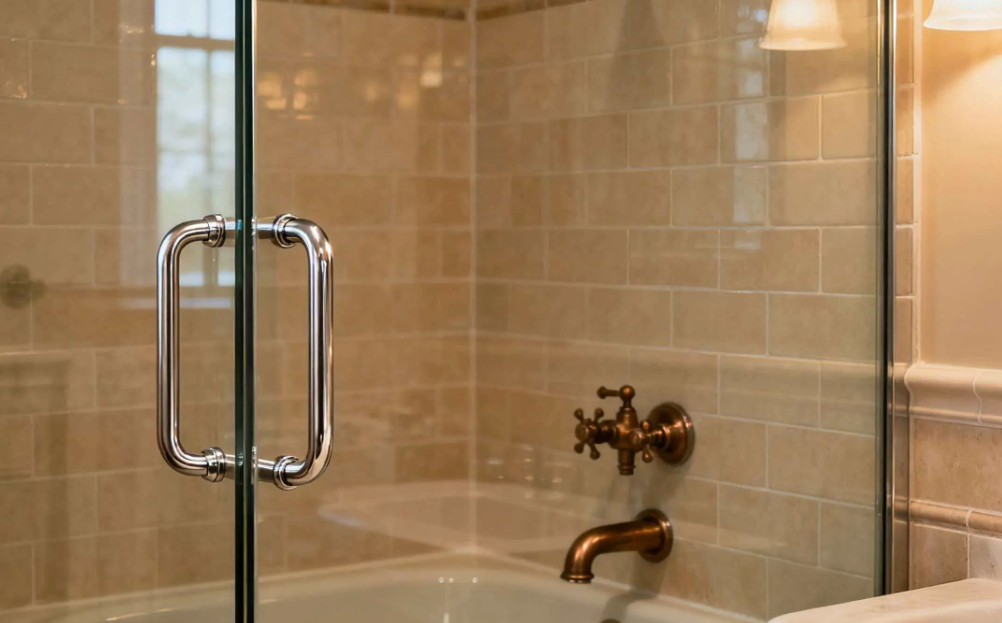
Every Shower Room Glass Accessory operates in one of the most demanding interior environments. Daily exposure to water, soap, heat, and cleaning chemistry increases the risk of corrosion and residue buildup. In a shower enclosure with a height of 1900 mm to 2200 mm, even a small loss of hardware alignment can affect door closure, seal compression, and user safety.
That is why material finish, seal compatibility, and moisture resistance are as important as attractive design. A polished or brushed stainless finish can improve maintenance and visual consistency, but the bigger point is structural: components must resist degradation over years of wet use.
A Stainless Steel Support Rod reinforces fixed glass panels by limiting flex across the top edge or side edge. In wider installations such as 1200 mm to 1500 mm, the rod adds stiffness and helps prevent gradual movement. If the rod includes adjustable ends, installers can fine-tune alignment within small ranges such as 5 mm to 15 mm.
This is important because unsupported panels can deflect under door movement or accidental human contact, so a support rod acts like a stabilizing spine for the glazing assembly. It is particularly useful when minimal framing is desired.
The Glass-to-Wall Bracket connects glass to masonry, tile, concrete, or framed substrates. Its role is simple in appearance but critical in performance. If the bracket body, fasteners, or anchors are not properly matched to the wall condition, structural integrity can be compromised regardless of glass quality.
For example, a bracket may be rated for a panel load of 40 kg to 60 kg, but the wall anchors may behave differently in hollow block compared with reinforced concrete. Good project planning therefore examines the full support chain, not just the visible hardware.
A Heavy Duty Glass Fitting is used when doors are taller, heavier, or more frequently operated. In commercial entries, office partitions, and premium residential applications, the hardware may need to support door masses of 50 kg to 100 kg and endure cycle counts in the tens of thousands. Oversimplifying this choice can create long-term distortion or premature component fatigue.
Heavy duty hardware matters because higher weight increases torque and dynamic load during opening, so the fitting must be sized with margin rather than chosen by appearance alone.
Among common hardware materials, stainless steel remains a preferred option for demanding glass applications. It offers a practical combination of strength, corrosion resistance, finish stability, and long-term dimensional reliability. In wet rooms, coastal sites, and high-use facilities, these benefits become more obvious over periods of 3 years to 10 years.
| Component | Typical Functional Range | Structural Benefit |
|---|---|---|
| Precision Glass Clamp | 8 mm to 12 mm glass | Even force distribution and reduced edge stress |
| Stainless Steel Support Rod | 800 mm to 1500 mm panel spans | Lower deflection and better alignment retention |
| Glass-to-Wall Bracket | 40 kg to 60 kg panel support | Reliable anchoring into wall structures |
| Heavy Duty Glass Fitting | 50 kg to 100 kg door masses | Higher cycle durability and reduced sagging |
Structural reliability starts long before installation. It starts in design, tooling, casting, machining, polishing, and inspection. Tight tolerances help ensure repeatable performance across production batches. If a slot dimension drifts by 0.50 mm, or a clamp face is not flat within intended limits, the installer may need to force the assembly into position. Forced fit is always a warning sign.
Dimensional consistency supports easier installation. Surface uniformity improves gasket contact. Proper machining reduces burrs and sharp transitions. These details matter because glass cannot absorb installation errors like soft materials can, so hardware precision directly affects safety margins.
Industry users often compare certifications, test reports, and sample inspections with guidance from organizations such as NIST, OSHA, CPSC, NSF, ASTM, and ISO. For technical glass research and materials reference, useful resources also include NGA, NFPA, U.S. Department of Energy, Smithsonian, MIT, and Carnegie Mellon University.
Even the best Glass Door Fittings can underperform if installed poorly. Incorrect drilling positions, uneven wall substrates, over-tightened screws, missing gaskets, or incompatible sealants can introduce stress into an otherwise well-designed system. Installation should account for glass thickness, door width, opening direction, wall condition, and expected daily use.
For example, if a door of 900 mm width and 45 kg mass is paired with hardware intended for a smaller panel, sagging may appear within 6 months to 12 months. If a wall bracket is mounted on an uneven tile surface by only 2 mm of offset, the glass may twist during tightening. Problems do not always appear immediately, which is why inspection after initial use is valuable.
For hardware selection and product categories, visit
this Glass Door Fittings page.
- ● They reduce movement at connection points, which lowers wear over time.
- ● They distribute pressure more evenly, which protects glass edges and holes.
- ● They maintain alignment, which improves closing action and seal performance.
- ● They resist corrosion in humid environments, especially in shower enclosures.
- ● They support predictable maintenance, making inspection and replacement easier.
These benefits reinforce one another. Better alignment reduces friction. Less friction reduces wear. Lower wear extends service life. This chain matters because durability is cumulative, so small engineering improvements often produce large lifecycle gains.
Buyers should review more than style and finish. Ask for material grade, glass thickness compatibility, weight rating, surface treatment, tolerance data, and recommended use environment. If the project includes a Shower Room Glass Accessory package, also confirm moisture resistance, cleaning compatibility, and gasket replacement availability.
A practical checklist includes:
Routine maintenance is not complicated, but it must be consistent. Inspect visible hardware every 6 months to 12 months for loosening, corrosion marks, finish damage, gasket compression loss, or changes in door alignment. Clean with non-abrasive products and avoid harsh agents that may attack seals or finishes.
If a door begins dragging, bouncing, or closing unevenly, treat it as a structural signal rather than a cosmetic inconvenience. A small adjustment made within 2 weeks can prevent much larger wear over the next 12 months.
Precision glass door fittings are important because they control how force passes through the glass system, so the panel remains stable instead of developing hidden stress points. When tolerances, clamp surfaces, and fastener positions are accurate within small ranges such as 0.10 mm to 0.30 mm, the hardware seats properly and supports long-term alignment. That means safer operation, less sagging, and better durability over 5 years to 15 years.
A Shower Room Glass Accessory must survive constant humidity, direct water exposure, soap film, and frequent cleaning. These conditions are harsher than a dry interior partition, so corrosion resistance, gasket quality, and surface finish become more critical. In a shower enclosure of 1900 mm to 2200 mm height, even small fitting issues can affect seal performance and door swing.
A Precision Glass Clamp protects the panel by spreading force across a controlled contact area rather than concentrating it at one sharp point. Correct gasket thickness, smooth clamp geometry, and proper torque settings help prevent slipping and edge stress. If the clamp body is not dimensionally accurate, the pressure can become uneven, which increases the risk of damage.
A Stainless Steel Support Rod is especially useful when a fixed panel spans about 800 mm to 1500 mm, or when the design minimizes framing for a cleaner appearance. The rod increases rigidity and reduces panel flex during door movement or accidental contact. This added stiffness helps preserve alignment and improves confidence in everyday use.
A Glass-to-Wall Bracket does more than connect two surfaces. It transfers load from the glass into the wall structure, so both the bracket and the anchor condition must be appropriate. A bracket rated for 40 kg to 60 kg may still underperform if installed into weak substrate conditions or uneven tile surfaces. The wall matters as much as the visible fitting.
Yes, in many cases a Heavy Duty Glass Fitting is worth the investment because it provides more load capacity and better endurance for larger doors or higher traffic. If a door weighs 50 kg to 100 kg or sees 100 cycles/day to 200 cycles/day, undersized hardware can wear quickly. Properly rated heavy duty fittings reduce fatigue and support longer service intervals.
For many residential and light commercial systems, inspection every 6 months to 12 months is a practical baseline. High-humidity spaces, public buildings, and frequently used doors may need shorter intervals. Look for loosening screws, corrosion marks, compressed gaskets, changes in closing behavior, or movement around brackets and clamps.
The biggest mistake is choosing by appearance alone without matching the hardware to glass thickness, door mass, support structure, and environment. A polished finish may look excellent, but if the fitting is not designed for 10 mm glass, 45 kg door weight, or wet-room exposure, performance problems can appear quickly. Good selection starts with function first and appearance second.
Glass Door Fittings are structural components, not simple accessories. Whether the application involves a Shower Room Glass Accessory, a Precision Glass Clamp, a Stainless Steel Support Rod, a Glass-to-Wall Bracket, or a Heavy Duty Glass Fitting, precision determines how safely and how long the system will perform. A well-designed fitting protects the glass, stabilizes motion, and maintains alignment over years of use. A poorly matched fitting does the opposite, even if it looks attractive on installation day.
As architectural glass continues to expand in 2026, buyers and project teams should focus on tolerance control, material quality, load matching, and installation discipline. Those choices matter because structural integrity is built through many small decisions, so the right hardware creates a safer, more durable finished system.
Learn more about product categories and specifications at
https://www.huazhuprecision.com/glass-door-fittings/