- Home
- Products
- About Us
- Solutions
- Our Service
- Contact Us
Leave Your Message
China’s aluminum tube sector spans large integrated mills, specialist extruders, and manufacturers serving demanding industrial markets. Choosing among the top 10 is not simply a matter of comparing prices or production capacity. Alloy grade, tube dimensions, wall consistency, surface finish, and quality controls all affect how a product performs in use. A tube destined for a heat exchanger has different priorities from one used in a bicycle frame or construction system.
As a practical framing, Aluminum Association technical expert John Green has emphasized the importance of matching material performance to the intended application. The principle is simple: a reliable Aluminum Tube begins with the right alloy and depends on disciplined process control. This is an editorial paraphrase, not a verified direct quotation. Buyers should still ask manufacturers for current specifications, inspection records, and evidence of relevant production experience.
This guide introduces ten Chinese manufacturers and the capabilities buyers may want to examine. Some suppliers focus on custom dimensions; others compete through scale, finishing options, or export experience. A polished catalogue is useful, but it does not answer every question. Requesting sample tubes and confirming tolerances can reveal practical differences that brochures leave out. No ranking can replace a clear project specification, and supplier information should be checked directly before making a decision.
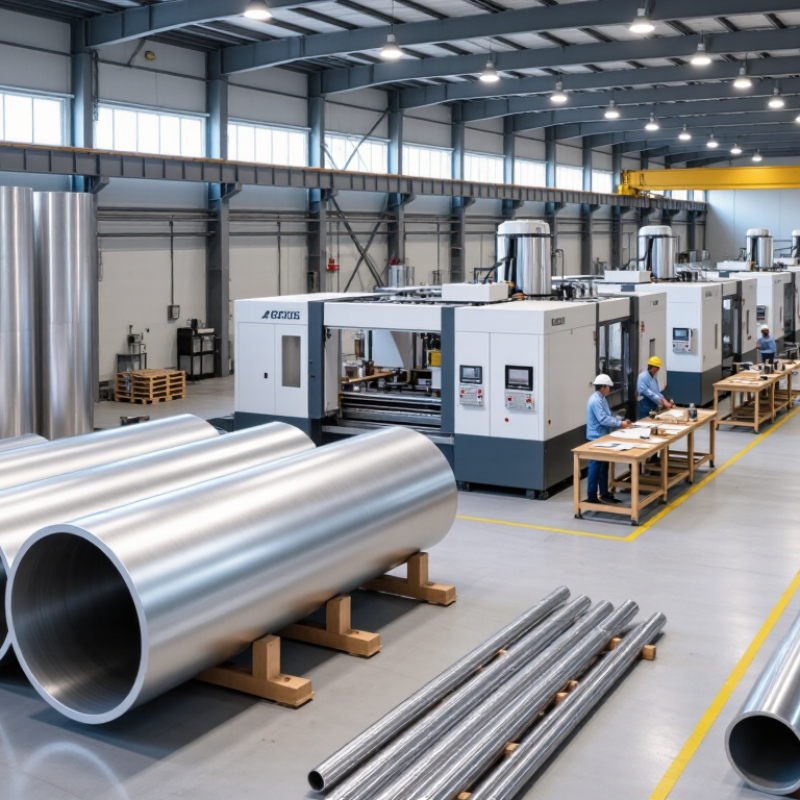
China’s aluminum tube manufacturing industry serves construction, transportation, machinery, heat exchange, and consumer products. Production ranges from extruded profiles to drawn tubes with tighter dimensional control. Some facilities also offer cutting, bending, and surface finishing, reducing work for downstream buyers.
Manufacturing capacity is spread across several industrial regions, with suppliers differing in equipment, alloy options, and production scale. A useful assessment goes beyond catalog breadth. Check alloy and temper availability, wall-thickness tolerance, tube straightness, and how each batch is inspected. Ask for test records and traceability details. Small variations matter.
A polished brochure is not proof of consistent production. Request samples, compare measurements, and clarify packaging and lead times before placing a large order. For critical applications, confirm that the supplier can document mechanical properties and repeatable quality checks. Not every factory controls every process in-house; that can complicate scheduling. It varies. Even experienced buyers can overlook details like end finish or protective wrapping, so specifications should describe the finished tube clearly.
This table summarizes ten common aluminum-tube product and process categories found in the industry; it is not a ranking of manufacturers. Alloy availability, dimensions, temper, tolerances, and certification depend on the producer and project specification.
| No. | Product or Process Category | Common Alloy Examples | Typical Production Route | General Characteristics | Common Applications | Relevant Specification Examples |
|---|---|---|---|---|---|---|
| 1 | General-purpose extruded tube | 6060, 6061, 6063 | Hot extrusion, followed by straightening and finishing as required | Available in round and shaped cross-sections; properties depend on alloy, temper, and dimensions. | Machinery, frames, structural components, and general fabrication | ASTM B221; EN 755 series |
| 2 | Architectural and decorative tube | 6060, 6063 | Extrusion; optional anodizing, coating, or other surface finishing | Commonly selected for extrudability and surface-finish requirements; appearance depends on finishing and handling. | Building components, display structures, and interior or exterior fittings | EN 755 series; project-specific finish requirements |
| 3 | Seamless extruded tube | 6061, 6063, and other specified alloys | Extrusion through a mandrel or piercing process, depending on the equipment and product | Produced without a longitudinal weld seam; dimensional capability is supplier- and specification-dependent. | Pressure-related components, precision parts, and general engineering | ASTM B241/B241M |
| 4 | Welded tube | 3003, 5052, 6061, and other specified alloys | Forming aluminum strip or sheet into a tube and joining the longitudinal seam | Seam quality, inspection, and final properties depend on the welding method and product specification. | Heat exchangers, furniture, automotive parts, and general fabrication | Applicable ASTM, EN, or customer-specific product specification |
| 5 | Heat-exchanger tube | 3003, 3103, 6061, and other application-specific alloys | Extrusion or tube forming; additional drawing or finishing may be used | Designed around heat-transfer, corrosion, pressure, and joining requirements; selection depends on the service environment. | Radiators, condensers, evaporators, and industrial heat exchangers | Applicable product specification and customer performance requirements |
| 6 | Marine and corrosion-service tube | 5052, 5083, 6061, and other specified alloys | Extrusion, welding, or other routes selected for the alloy and design | Corrosion performance varies with alloy, temper, exposure conditions, and fabrication details. | Marine structures, transport equipment, and corrosion-exposed components | Applicable alloy and product standards; project requirements |
| 7 | High-strength engineering tube | 6061, 6082, 7005, 7075 | Extrusion or other specified forming route, followed by the required heat treatment | Strength and formability depend on alloy, temper, section geometry, and heat treatment. | Transportation, sporting equipment, and load-bearing engineering parts | ASTM B221 or EN 755 series, where applicable |
| 8 | Precision-drawn tube | 1050, 3003, 6061, and other suitable alloys | Drawing through a die, often using an extruded or welded tube as feedstock | Drawing can improve dimensional control and surface consistency; achievable tolerances must be agreed with the supplier. | Instrumentation, fittings, automotive components, and precision assemblies | Applicable tube standard and agreed dimensional tolerances |
| 9 | Multiport or microchannel tube | Commonly selected from suitable 1xxx or 3xxx series alloys | Specialized extrusion, often with multiple internal channels | Thin-walled, multi-channel designs are engineered for heat-transfer applications; geometry is product-specific. | Air-conditioning and automotive heat-exchanger systems | Customer drawing and application-specific performance requirements |
| 10 | Custom-profile and non-round tube | 6061, 6063, 6082, and other extrusion-suitable alloys | Custom-die extrusion; secondary machining or finishing may be added | Cross-section, wall thickness, and tolerances are defined by the drawing and manufacturing feasibility. | Equipment housings, structural assemblies, rails, and bespoke components | ASTM B221 or EN 755 series, where applicable; approved drawing |