China Top 10 Door Handle Manufacturers for Global Buyers
Choosing a Door Handle supplier is not simply a search for attractive designs. Global buyers must assess material consistency, machining accuracy, finish durability, and production discipline. A polished showroom sample can hide weak internal controls. This guide introduces ten China-based manufacturers relevant to international projects, from residential renovations to hotel developments and commercial fit-outs. The selection focuses on visible product quality and the less visible systems behind it. These include inspection procedures, traceability, testing records, OEM flexibility, packaging, and communication.
A dependable factory should explain its alloy grades clearly. It should also show how handles survive repeated use, humidity, cleaning chemicals, and transport. Details matter. A loose spindle, uneven coating, or poorly protected carton can create expensive site delays. Buyers should request samples, technical drawings, finish cards, third-party test reports, and current compliance documents before placing volume orders. Factory audits and small trial orders remain sensible safeguards. They are not perfect, though. Website claims may be incomplete, and factory capacity can change during busy seasons. This overview therefore offers a practical starting point, not a substitute for independent verification. Each Door Handle manufacturer deserves review against your specifications, target market, installation environment, budget, and after-sales expectations. The strongest partnership is rarely the cheapest quote. It is the supplier that communicates honestly when a design needs improvement. That matters.
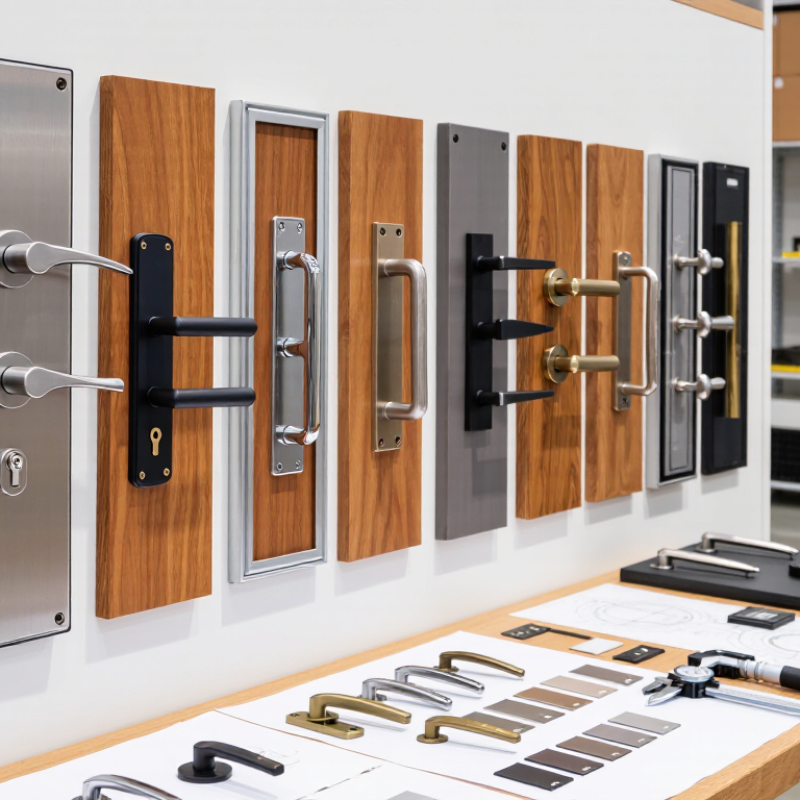
China’s Door Handle Industry: Market Scale, Export Trends, and Key Data
China Top 10 Door Handle Manufacturers for Global Buyers
China’s door handle industry has developed into a large, export-focused manufacturing base. Production is concentrated in Guangdong, Zhejiang, and Jiangsu, where factories support casting, stamping, CNC machining, polishing, and surface finishing. Recent customs data shows strong shipments to Europe, North America, Southeast Asia, the Middle East, and Latin America. Demand covers stainless steel levers, zinc alloy pulls, privacy handles, and fire-rated hardware components.
The market is competitive, but not uniform. Large manufacturers often serve hotel projects and construction distributors, while smaller workshops handle customized orders and short production runs. Export quotations commonly depend on alloy grade, coating thickness, packaging, mold costs, and order volume. A buyer may compare several factories and still find major differences in salt-spray performance, assembly tolerance, and carton protection. Small details matter.
Market size estimates require caution. Door handles may appear under different customs classifications, so public trade data rarely provides one perfectly clean figure. This creates gaps between reported export value and actual industry activity. Buyers should verify factory audits, material certificates, sample consistency, and shipment records before signing contracts. In practical sourcing, a polished sample is not enough. Production control matters more. China remains highly capable, yet quality can vary sharply between suppliers, and that reality deserves closer review.
How to Rank China’s Top 10 Door Handle Manufacturers Using EN 1906 Grades
China Top 10 Door Handle Manufacturers for Global Buyers
Ranking China’s top door handle manufacturers requires more than comparing price, design, or factory size. EN 1906 offers a clearer technical framework. Its classification covers use category, durability, door mass, fire performance, corrosion resistance, security, and operation type. Category grades range from Grade 1 for light domestic use to Grade 4 for very high-frequency public use. A reliable manufacturer should provide complete classification data, not only a single grade.
For a practical ranking, buyers can review independent test reports, production consistency, material traceability, and quality control records. Check whether stainless steel, zinc alloy, or aluminum samples match the approved specification. Examine surface coating after salt-spray testing. Also compare cycle-test results, packaging strength, replacement policies, and delivery records. A high EN 1906 grade is valuable, but it does not automatically prove stable factory performance. This method is useful, though not perfect.
Tips: Request the full eight-digit EN 1906 classification. Confirm the testing laboratory and report date. Ask for samples from different production batches. Test installation on real doors, including latch alignment and handle return. Keep written records. Small details matter. A supplier that answers technical questions clearly often deserves a higher position than one offering attractive prices without evidence.
Top 10 Chinese Door Handle Manufacturers by Materials, Capacity, and Certifications
China’s top ten door handle manufacturers should be compared by material control, production capacity, and certification depth. Grand View Research estimates that the global door hardware market will continue growing through 2030, supported by construction and renovation demand. However, market figures vary between reports. Buyers should treat forecasts as directional, not absolute.
A practical shortlist includes manufacturers specializing in stainless steel, brass, zinc alloy, aluminum, and engineered materials. Stainless steel suits coastal projects because it resists corrosion. Brass offers weight and a warmer architectural finish. Zinc alloy supports detailed shapes and competitive pricing. Leading factories may operate die-casting, forging, polishing, plating, and assembly lines under one roof. Monthly capacity can range from tens of thousands to several hundred thousand sets, depending on automation and product complexity. Capacity alone proves little.
Certification deserves closer inspection. ISO 9001 indicates a documented quality system, while ISO 14001 addresses environmental management. For commercial projects, buyers should request test evidence aligned with EN 1906, ANSI/BHMA standards, or relevant ASTM methods. SGS and Intertek reports can support independent verification, but they do not replace factory audits. Check salt-spray hours, cycle-test results, coating thickness, and batch traceability. A sample may perform well while mass production drifts. That risk is often overlooked. Good sourcing still requires production records, random inspections, and honest review of rejected samples.
Product Quality Benchmarks: EN 1906, ANSI/BHMA A156.6, and ISO 9227
China Top 10 Door Handle Manufacturers for Global Buyers
For global buyers, EN 1906 offers a practical durability benchmark. Its highest durability grade requires 200,000 operating cycles, while Grade 6 requires 100,000 cycles. That difference matters in hotels, schools, and busy offices. EN 1906 also classifies corrosion resistance from Grade 0 to Grade 5. Grade 5 represents 480 hours in a salt-spray test. Ask manufacturers for complete test reports, not attractive samples. Samples can hide weak springs, loose fixings, or uneven plating.
ANSI/BHMA A156.6 focuses on architectural door trim, including dimensions, mounting details, materials, and finish requirements. Buyers should compare drawings against the standard before approving production. A handle may look correct but fail during installation. Small errors matter. ISO 9227:2022 defines neutral, acetic acid, and copper-accelerated salt-spray methods. It does not set one universal pass-or-fail duration. Therefore, a supplier claiming “500-hour protection” needs to state the test method, coating system, preparation, and acceptance criteria.
Independent laboratory evidence strengthens supplier evaluation. Request batch numbers, substrate details, coating thickness, and photographs after testing. Industry testing practice shows that salt spray cannot fully predict outdoor service life. That limitation deserves attention. A careful purchasing team should combine EN 1906 cycle results, A156.6 dimensional checks, and ISO 9227 evidence. I would also repeat selected tests after shipping. Packaging damage can expose tiny edges, and tiny edges often become the first corrosion points.
Global Buyer Guide: MOQ, Lead Times, Customization, Compliance, and Total Cost
China Top 10 Door Handle Manufacturers for Global Buyers
A reliable comparison starts with MOQ, not catalog variety. Many factories quote 100 to 500 sets for standard handles, while customized finishes may require 1,000 sets or more. Smaller MOQs usually increase tooling and packaging costs. Confirm whether samples count toward the first order. They often do not.
Lead times commonly range from 25 to 45 days after approval. Complex finishes, engraving, and mixed materials can add two weeks. The World Bank’s 2023 Logistics Performance Index measures shipment timeliness on a 1–5 scale, so buyers should assess export performance, not only factory price. Ask for recent production records, inspection photos, and a written delay procedure. These details feel basic. They are often missing.
Customization should cover dimensions, spindle size, mounting screws, surface treatment, cartons, and testing documents. For commercial projects, check applicable requirements such as corrosion resistance, cycle testing, and restricted-substance controls. ISO’s 2023 Survey recorded more than 1.2 million ISO 9001 certificates worldwide, but certification alone does not prove consistent hardware quality. Request batch inspection results. I have seen attractive samples fail during repeated-use testing. Total cost must include molds, samples, inland transport, freight, duties, inspection, defects, and warranty replacements. A cheaper handle can become expensive after installation delays. Calculate landed cost per usable set, not quoted unit price.